
Citizen 2025 | Flexible futures and the presenteeism paradox
Little did we know when we wrote our 2015 report how poignant some of our predictions would become as flexible and remote working became the norm overnight, thanks to the Covid-19 pandemic.
Letting go of ‘presenteeism’
“People want to be able to work how, where and when they want. With a more robust minimum wage, part-time work as standard, truly flexible working and ultimate connectivity enabling ‘remote-first’ businesses, there’s a perfect storm brewing for a generation of multiple starters-uppers and the rise of the portfolio career. The issue of ‘presenteeism’ will simply have to be dealt with openly, with a large element of trust.”
With the onslaught of Covid rapidly accelerating the notion of working ‘how, where and when’ people wanted to, or indeed could, this trust and letting go of presenteeism was thrust upon employers.
The hybrid compromise
While there has been a preference to move back to the office from some employers during the last couple of years, whether through concerns around trust or productivity, the majority have adopted a hybrid model with a combination of working from home and in office becoming standard practice. The Office for National Statistics (ONS) reported that in the three months January to March 2025, 28% of UK working-age adults followed a hybrid working pattern, with professionals (workers with a degree or equivalent) 10 times more likely to work in a hybrid way.
In our original research in 2015, 32% of our focus group thought that by 2025, 21-30% of the population would work flexibly, perhaps with more than one job. Echoing this sentiment, only 20% of the 2,000 UK working-age adults we surveyed expected work to consist of a full-time traditional ‘in office’ working week by 2025.
Fast-tracked flexibility
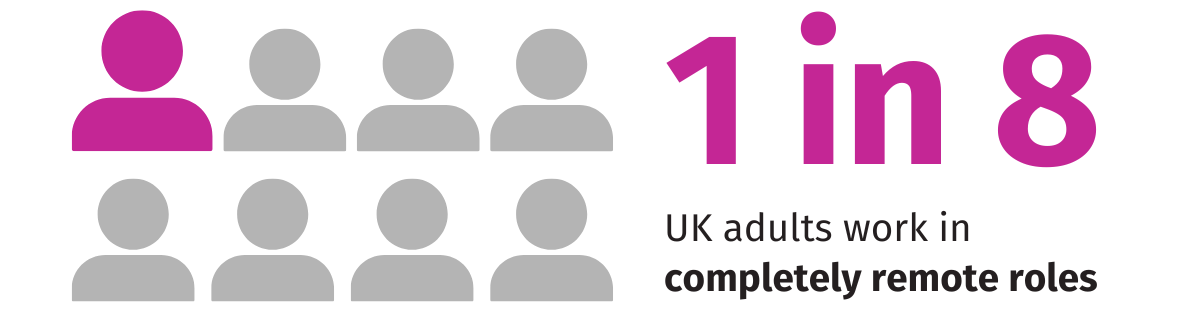
Fast forward 10 years, and this has become a reality. Research has found that 40% of UK adults worked remotely during 2025, and one in eight (14%) worked in completely remote roles. Working from home was also particularly popular among middle-aged employees, with nearly half (49%) of 30–49-year-olds working from home some or all the time.
The move towards working flexibly has, of course, been given a fast track by Covid. However, legislation has also evolved to provide the infrastructure for it to happen. The updated 2024 flexible working regulations, for example, make it possible for employees to request flexible working arrangements from day one.
A shift “turbo-charged by legislative updates”
“We’ve seen a rapid shift to flexible and remote working, which presents both exciting opportunities and significant challenges in employment law. This transformation has certainly been turbo-charged by legislative updates, such as the Employee Relations (Flexible Working) Act 2023, which now allows employees to request flexible arrangements from day one.
This legislative shift reflects a broader societal acceptance that work is not tied to a physical location but rather to the outcomes employees can and must deliver. However, as we embrace this flexibility, employment law must continue to evolve. Employers must be mindful not only of the legal rights surrounding flexible working requests but also of potential complexities such as ensuring equitable treatment across diverse workforces, protecting mental health in a remote context, and ensuring that productivity remains.
I believe employers need to consider how they balance flexibility with business needs. For example, hybrid working models introduce new considerations for managing team dynamics, performance, and employee engagement in an increasingly digital world. While the future of work looks promising, employers and employees both need to stay informed about the ever-changing legal landscape, including changes to unfair dismissal rights, employee protections, and the legal handling of flexible working requests.
Ensuring that an employer’s policies and procedures are legally compliant and fit within the company’s wider operational framework is and will continue to be critical.”
– Samantha Castle, Head of Employment Law
Navigating your employment rights in a shifting legal landscape
Of course, any flexible or remote working requests and agreements need to work for both the employee and employer. Plus, operate within the regulatory framework to ensure arrangements are within the law. Making sure you know your rights as an employee and an employer is a good investment of time, not least with employment law being subject to regular updates.
As a starting point, our recent blog provides a useful roadmap on the upcoming changes to the Employment Rights Bill taking place between now and 2027. Other useful information regarding employment law rights and responsibilities, such as day-one unfair dismissal rights and how to handle a flexible working request, can be found on our Updates and Media page.
How our employment lawyers can help
For straightforward advice about your employment rights or responsibilities, as an employee or employer, get in touch. Call us on 0117 325 2929 or fill out our enquiry form, and we will be in touch.