

Citizen 2025 | Grey ‘go-getters’ or ‘must-getters’? The changing face of the older workforce
In our 2015 report, we coined the phrase ‘grey go-getters’, predicting that with life expectancy rising and access to better health care, we’d see an increasingly grey workforce by 2025. So where are we now?
A decade of change: how the older workforce has grown
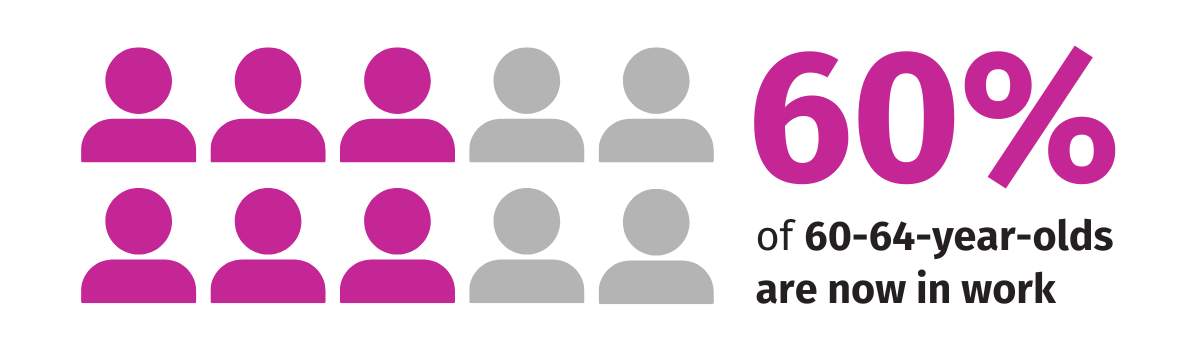
According to official Government figures, this grey workforce has grown considerably in the past decade, rising from 40% of 60 to 64-year-olds in work in 2014 to 60% in 2024. Similarly, the number of over-60s who are self-employed has risen by a third (33%) during the past 10 years.
Ambition or necessity?
What’s not as widely documented, however, is whether this is driven by ambition or need. With the cost of living showing no signs of slowing and the retirement age increasing, are these ‘grey go-getters’ in fact grey ‘must’ getters?
In our Citizen 2025 report, 50% of our legal focus group thought the retirement age would likely be 70 by 2025. While this hasn’t happened yet, many fear that the Government’s pensions review commission, which will conclude in 2027, may end up nudging retirement age upwards to 70. Already, by 2027, the retirement age will be 67, rising to 68 eventually, compared to 65 currently.
When asked about their hopes for retirement, our 2015 survey of 2,000 working-age UK adults found that 29% expected to retire aged 66 to 70, with 21% planning to stop work aged between 61 and 65.
Is ‘never really retiring’ becoming the norm?
However, many industry commentators fear that these plans are not coming to fruition, with many older people forced to continue working past their ideal retirement age. Age UK refers to this trend as the ‘Great Unretirement’, with research from Scottish Widows finding that 54% of people are working past the age they wish to, with the majority preferring to have been able to stop work at 62. Government figures also reported that only 44% of the current UK workforce expect to retire before 66.

Another phenomenon is people continuing to work into ‘retirement’, with 25% of UK adults stating they expect to ‘never really retire’ according to the Phoenix group. 41% believe this will become the norm in the next 10 to 25 years. We dug deeper into the breakaway from a ‘pipe and slippers’ retirement here.
Whatever the situation, whether choosing to work, doing so out of necessity or somewhere between the two, the value and contribution of older workers is not to be underestimated. Think Tank, the Centre for Ageing Better, cites many reasons why older workers can be good for business, including productivity, knowledge and skill sharing with younger generations.
What employers need to know about age in the workplace
As well as the benefits of embracing an older workforce, employers also need to be aware of their legal obligations to their employees. Age discrimination is against the law and is one of nine protected characteristics set out in the Equality Act 2010.
Where this can be less black and white is in certain professions where age limits are set based on physical grounds (e.g. the Police force or military) or within organisations where there is an agreed employment policy on ‘stand down’ age. This could apply to a leadership/ownership position, a trustee, or board member, for example.
Contact our employment law solicitors
Whether in a private or public sector setting, both employers and employees should make sure they are aware of their rights and obligations regarding age and employment.
For advice and guidance from our specialist employment lawyers, call us on 0117 325 2929 or fill out our enquiry form.